BONDED MATERIALS
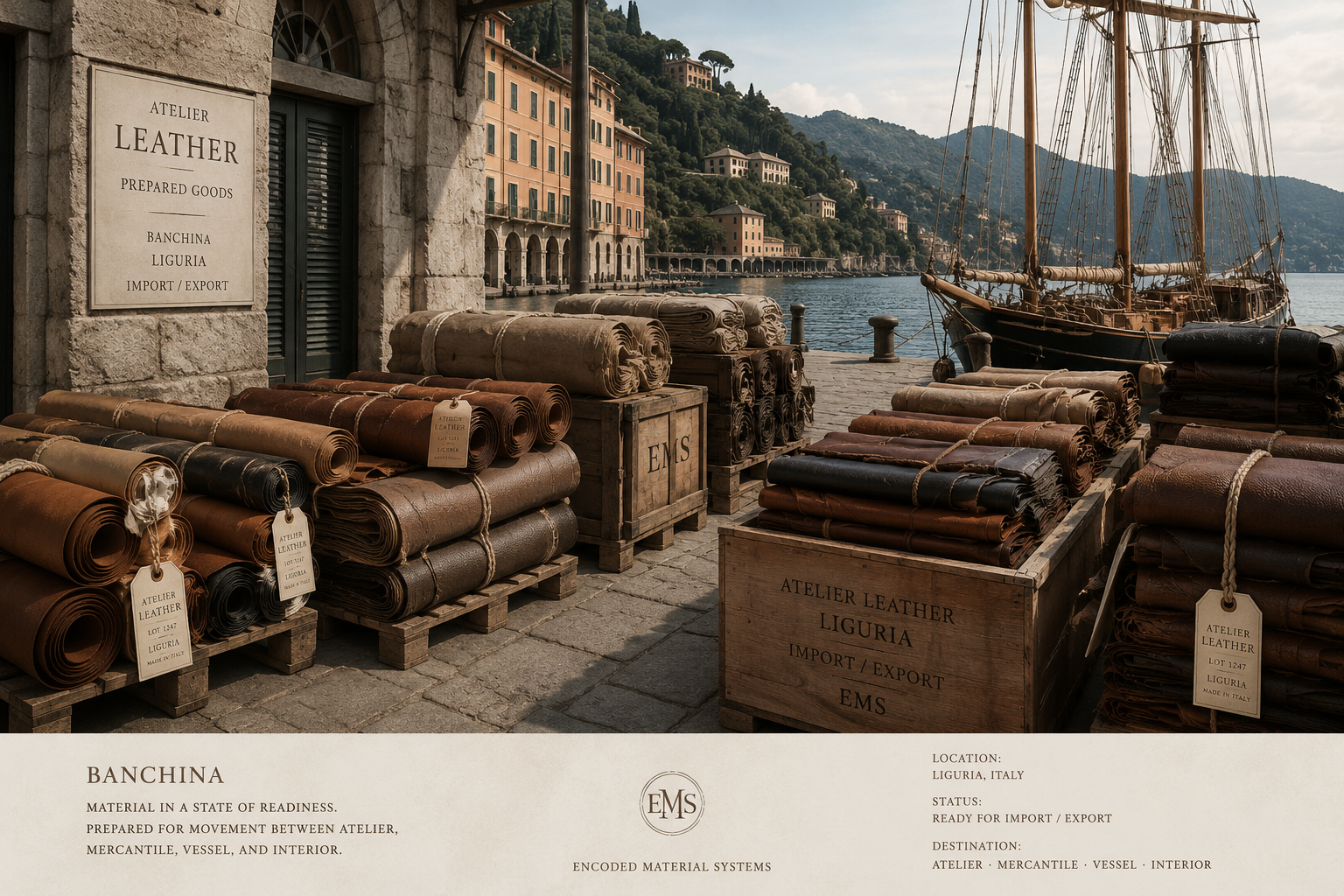
LEATHER
PORCELAIN
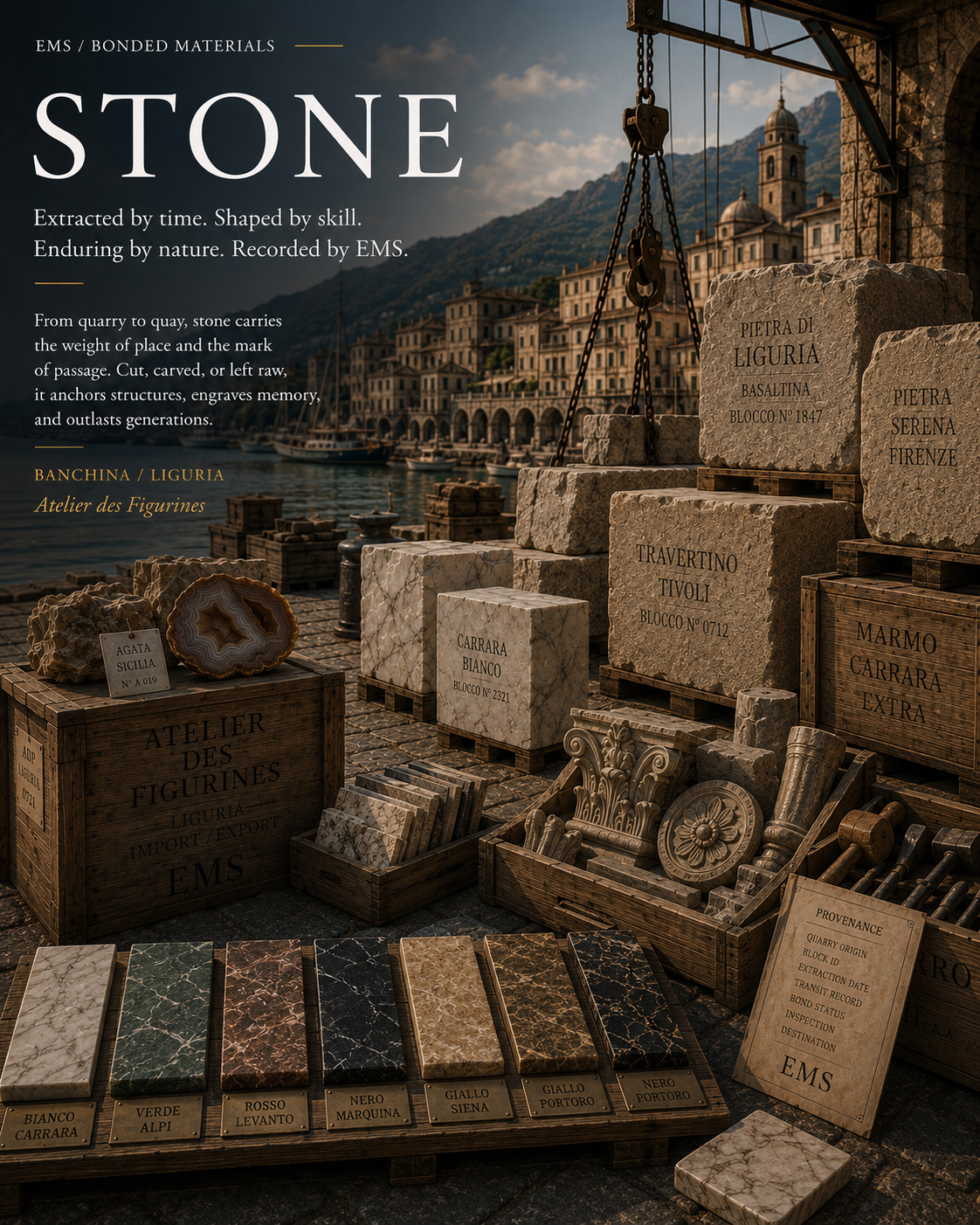
STONE
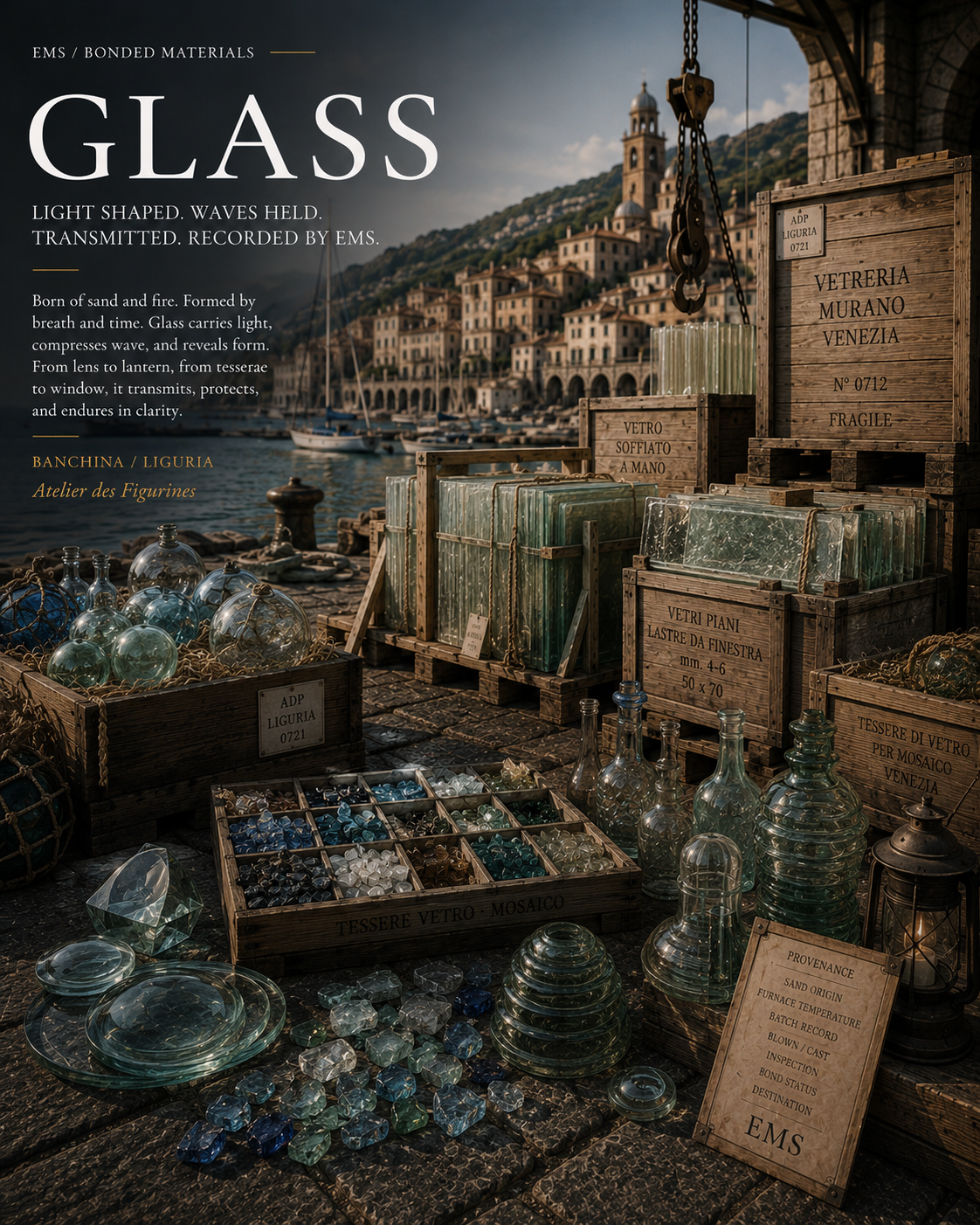
GLASS
METAL
BONDED MATERIALS
Material in Relation
Leather remains leather.
Porcelain remains porcelain.
Glass remains glass.
Metal remains metal.
Stone remains stone.
The Atelier does not improve these materials by renaming them, nor does composition erase the properties they possessed before arrival.
Its work begins when independently constituted materials are brought into consequential relation.
The material precedes the bond.
The composition determines the relation.
A bond may join unlike materials permanently.
It may hold them temporarily.
It may permit movement.
It may establish tension.
It may protect one material with another.
It may separate materials that must remain apart.
It may create an interface through which different properties can operate together.
Within the Atelier, bond does not require physical union. A bond exists wherever the placement, separation, orientation, or attachment of one constituted material becomes consequential to another.
The constitutional question is therefore not merely:
What are these materials?
That question belongs upstream.
The Atelier asks:
What can these materials truthfully become together?
THE BOND
A bond is a compositional relation through which the available behaviors of separately constituted materials become consequential to a common instance.
Leather wrapped around metal does not become metal.
Metal threaded through leather does not become leather.
Porcelain seated within brass does not collapse into a new fictional substance merely because the two now operate together.
Their distinction remains recoverable.
Their relation becomes consequential.
This permits the Atelier to compose across difference without treating difference as defect.
Bonding is relation without compulsory collapse.
MATERIAL FAMILIES
LEATHER
Leather contributes flexibility, tension, protection, friction, accommodation, and a surface capable of recording use.
Its grain, thickness, temper, finish, and condition constrain what relations it can bear.
The Atelier may cut, fold, stitch, wrap, tension, line, reinforce, or leave it substantially untouched.
Its properties are not conferred by the Atelier.
Their arrangement is.
PORCELAIN
Porcelain contributes rigidity, surface precision, thermal behavior, translucency or opacity, and controlled fragility.
It may be seated, tiled, inset, separated, suspended, protected, or joined through an intermediate material.
Its brittleness is not a failure to behave like leather.
It is a condition of composition.
STONE
Stone contributes mass, compression, abrasion resistance, thermal persistence, texture, and geological particularity.
It may provide foundation, counterweight, bearing surface, enclosure, marker, or contrast.
The Atelier works with its weight rather than pretending the weight away.
GLASS
Glass contributes transmission, reflection, enclosure, surface continuity, optical behavior, and fracture characteristics.
It may reveal another material while remaining physically separate from it.
A transparent boundary is still a boundary.
METAL
Metal contributes strength, conductivity, ductility, spring, hardness, fastening capability, reflectivity, and load transfer according to its particular composition.
It may frame, join, tension, conduct, reinforce, hinge, fasten, or bear.
“Metal” does not erase the distinction between bronze, steel, aluminum, tungsten, brass, or other constituted materials.
Where the distinction matters, the composition must preserve it. Metal depending on its specifications, will soften and melt whereas stone has more consistent heat tolerance.
INTERFACES
The most important part of a bonded composition is often neither constituent alone.
It is the interface.
At an interface, incompatible properties must coexist without being confused.
Hard meets soft.
Rigid meets flexible.
Conductive meets insulating.
Transparent meets opaque.
Heavy meets light.
Permanent meets replaceable.
The quality of the composition depends upon whether that transition has been resolved truthfully.
A successful interface does not require materials to behave alike.
It gives their differences somewhere to go.
METHODS OF RELATION
Bonding may occur through:
stitching
fitting
fastening
wrapping
laminating
seating
inlay
tension
compression
adhesion
hinging
interlocking
suspension
containment
spacing
adjacency
No method is constitutionally preferred merely because it produces the strongest physical attachment.
The appropriate bond is the one sufficient for the intended composition.
A reversible fitting may be superior to permanent adhesion.
A gap may be more truthful than a joint.
A liner may permit two otherwise incompatible materials to coexist.
And sometimes the correct relation is maintained separation.
DIFFERENCE AS CAPABILITY
The Atelier does not seek material uniformity.
Its compositional field exists because materials are different.
Leather can do what porcelain cannot.
Porcelain can do what leather cannot.
Glass admits light differently from stone.
Metal carries loads differently from textile.
Composition becomes valuable when those differences are arranged so that one material’s capability can meet another’s limitation without falsifying either.
This is not compromise.
It is fit.
FROM BANCHINA TO INSTANCE
At the Banchina, materials are present in readiness.
Here, selected materials acquire relation.
The relation is then tested through making.
Some bonds hold.
Some expose incompatibility.
Some require another material, another geometry, another method, or greater separation.
Some should never have been made.
Inspection makes those differences visible.
The Atelier may refine the relation, release it, dismantle it, or return its constituents to another available state.
Bonding therefore does not create perpetual custody.
Nor does composition require irreversible union.
What matters is that the resulting relation remain intelligible.
Materials arrive separately constituted.
The Atelier establishes relation.
The instance records what that relation made possible.