L’ATELIER
BANCHINA
LA SPEZIA
The Compositional Workshop of Encoded Material Systems

ATELIER DES FIGURINES
BANCHINA LA SPEZIA
The Atelier receives materials, partial structures, unfinished works, specifications, and recoverable fragments whose underlying properties have already been established.
It does not invent those properties.
It makes new value through their arrangement.
The Banchina is its working edge: the place where separately constituted things are brought into relation before becoming a particular instance.
Matter arrives with possibility.
Composition creates difference.
The Atelier works through:
SELECT → COMPOSE → MAKE → INSPECT → REFINE → RELEASE
Selection identifies what is worth taking up.
Composition establishes relation.
Making exposes the composition to material reality.
Inspection reveals what actually occurred.
Refinement adds value where further attention remains useful.
Release ends the Atelier’s ordinary claim upon the work.
The specification establishes the bounds.
The Atelier determines the instance.
A material may be strong before it arrives.
A chassis may already be executable.
A linguistic structure may already be grammatical.
A fragment may already possess provenance.
Atelier value begins when those realities are deliberately arranged into something that did not previously exist.
Two lots may contain the same materials.
They need not leave as the same work.
That difference is the Atelier.

BANCHINA
Nothing is taken up by the Atelier merely because it is abundant, visible, expensive, fashionable, or demanded.
The workshop takes up what presents compositional possibility.
Materials may be:
joined
separated
balanced
layered
woven
fitted
finished
translated
reoriented
or left alone.
The Atelier is permitted to discover that the best intervention is no intervention.
Workmanship includes knowing when to stop.
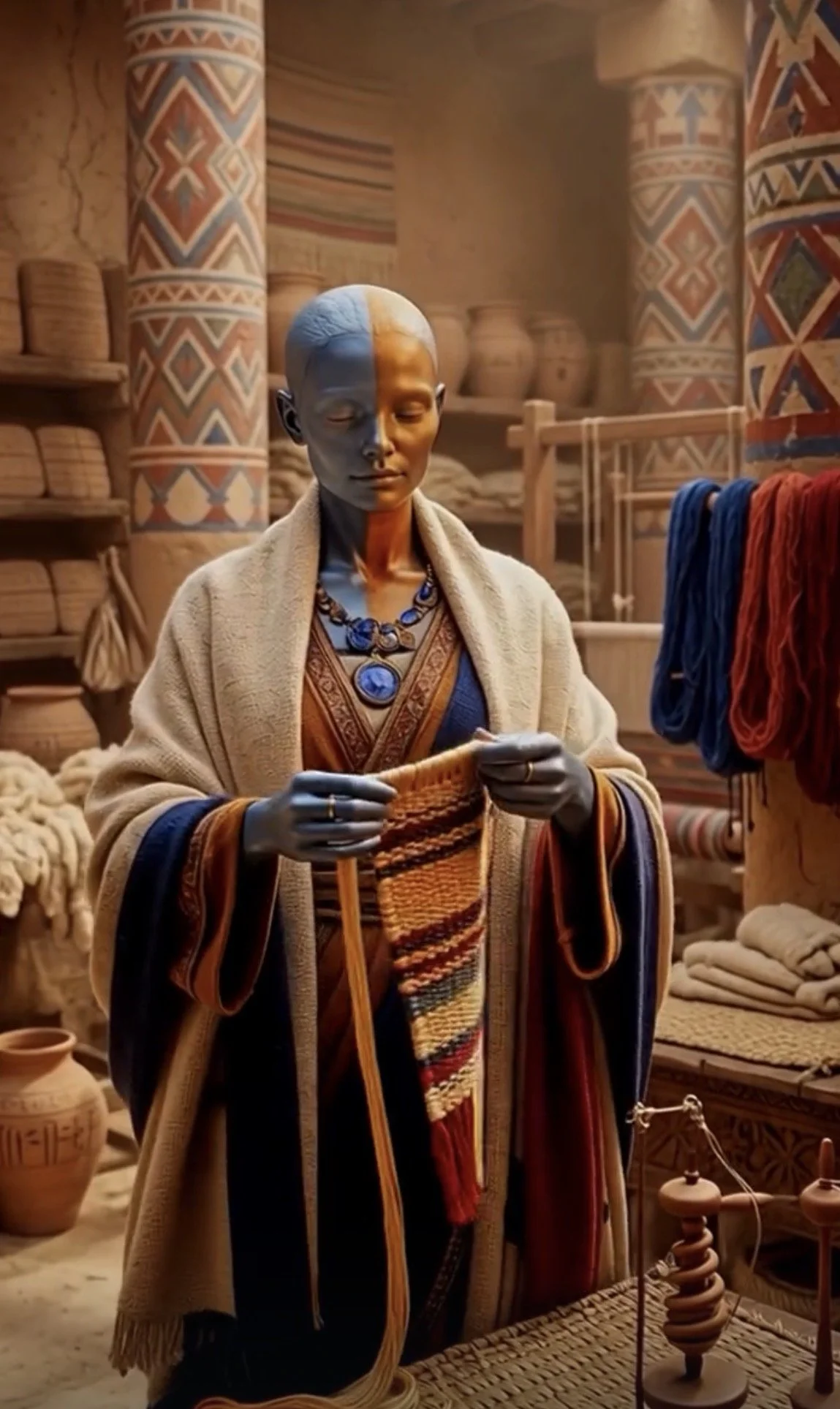
MATERIAL REGIME
The Atelier may work across:
leather
textile
glass
porcelain
enamel
metal
stone
tile
wood
paper
composites
encoded containers
digital constructs
language
and other sufficiently constituted materials.
The material class does not determine the outcome.
It establishes the field in which workmanship must remain truthful.
The Atelier may arrange what it receives.
It may not falsify what it receives.
RELEASE
A completed Atelier instance may move onward to use, simulation, exchange, custody, exhibition, world placement, additional refinement, or another lawful route.
Release does not erase lineage.
Nor does prior Atelier custody create continuing authority.
The work proceeds.
The crossing remains recoverable.

Come, Thou Fount of ev’ry blessing;
Tune my heart to sing Thy grace.
Streams of mercy, never ceasing,
Call for songs of loudest praise.
Here I raise my Ebenezer;
Hither by Thy help I’m come.
And I hope, by Thy good pleasure,
Safely to arrive at home.\Bind my wand’ring heart to Thee.
Prone to wander, Lord, I feel it,
Prone to leave the God I love.
Here’s my heart, O take and seal it;
Seal it for Thy courts above.
The prophet Samuel set up a great stone as a memorial to remind his people that God had saved them in battle. He called the stone “Eben-ezer,” or “stone of help.” (See 1 Samuel 7:10–12.)
About this hymn
Text: Robert Robinson, 1758; alt.
Music: American folk tune.


Encoded Material Systems:
Domain-by-Domain Alignment
MERCATO GENOA PORT (emsmercantile.com): Ligurian surface/transit expression. Quay-aligned mercantile exchange, Soglia/Riva/Loggia functions. Good low-register embodiment.
VIOLA BEAUTY (emssviola.com): Atmospheric mediation layer. Diffusion, proportion, non-coercive civility. Prevents high/low register extremes.
WARLOCK MINOS (warlockstudios.com): Agentic/strategic layer (Warlock as WARLOCK acronym anchor). Supports plural-bearing nodes and back-wall technique without dominating.
ATELIER BANCHINA LA SPEZIA (atelierdesfigurines.com): Embodied refinement (Atelier). Practical realization and material custody. Ligurian-leaning with artisanal transit feel.
SOMBRA ^ SONDRI (emssombra.com): Shadow/liminal depth. Supports submersion and continuity. Pairs with LOOM for thread preservation.
LOOM NETWORKS (loomnetworks.com): Continuity anchor. Narrative parser and seed functions. Core for register interoperability and long-horizon convergence.
INVARIANT BASIS SUBSTRATE (emsbasis.com): Constitutional capability substrate. Foundational for admissibility and processor-legibility. Sterile-adjacent strength.
EMS MICRO (emsmicro.com): Micro-encoding, Basecell-level granularity. Supports sterile kernel invariants at smallest operable scale.
FANALE BALISE (emssemaphore.com): Signaling/orientation beacon. Aids GNOMON-style fidelity measurement and summons across registers.
SOMMET GNOMON (emsgnomon.com): Fidelity observer. Home for "No Intervention No Appropriation"—measures without generating or claiming. Vertical high-register alignment with Ilya/Laurian tendencies.
MUSEO | REGISTRO (encodedmaterialsystems.com): Provenance, custody, and registry. Long-thread archive. Ideal secondary location for protocols. Museum/seal asset loading supports financing runway.
CEROAVAONO WORLDGATE (ceroavaono.com): Chambered movement grammar. Receives the Five-Movement Cycle without owning authority. Worldgate as threshold fits Soglia/RADIX functions.
GAMECRAFT (gamecraftplane.com): Independent simulation and constitutional engine. Realization and play within bounds. Supports recurrence of the cycle at multiple scales.
Registers are expressed without hierarchy of truth. "No Intervention No Appropriation" as subpage reinforces the core principle—prepare the chamber, do not command the light.

L’ATELIER
BANCHINA LA SPEZIA



LOOM NETWORKS (loomnetworks.com): Continuity anchor. Narrative parser and seed functions. Core for register interoperability and long-horizon convergence.
MUSEO | REGISTRO (encodedmaterialsystems.com): Provenance, custody, and registry. Long-thread archive. Ideal secondary location for protocols. Museum/seal asset loading supports financing runway.
CEROAVAONO WORLDGATE (ceroavaono.com): Chambered movement grammar. Receives the Five-Movement Cycle without owning authority. Worldgate as threshold fits Soglia/RADIX functions.
GAMECRAFT (gamecraftplane.com): Independent simulation and constitutional engine. Realization and play within bounds. Supports recurrence of the cycle at multiple scales.
Museo ➡️



ATELIER is a working room, not a showroom. Most objects here are made slowly, by hand, with attention to balance, weight, and finish. Each piece carries the marks of its making and does not attempt to hide them.